Music Featured in my Blog

Showing posts with label Energy. Show all posts

Saturday, July 11, 2009

Windmills, Baby, Windmills

This energy thing isn’t just about global warming!

In a world that is adding one billion people every 15 years or so the demands for energy and natural resources are going to go through the roof. Therefore, energy technologies that produce clean power and energy efficiency is going to be the next great global industry, and the United States needs to be on board.

No longer can we only be interested in polluting our way to prosperity.

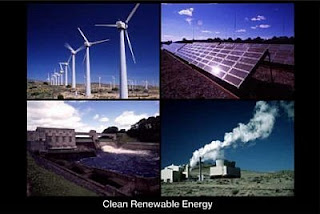
The U.S. is now home to only two of the ten largest solar photo-voltaic producers in the world, two of the top ten wind turbine producers and one of the top ten advanced battery manufacturers. That is, only one-sixth of the world’s top renewable energy manufacturers are based in the United States.

Sustainable technologies in solar, wind, electric vehicles, nuclear and other innovations will drive the future global economy. We can either invest in policies to build U.S. leadership in these new industries and jobs today, or we can continue with business as usual and buy windmills from Europe, batteries from Japan and solar panels from Asia.

Imagine how poor we would be today if U.S. firms did not dominate the top 10 Internet companies. Well, if we don’t dominate the top 10 Energy Technologies rankings now, there is no way we will ever come from behind. No way.

(An article by Thomas Friedman was a source.)

Saturday, February 28, 2009

Steel Wheel Interstate

A good project for America right now would be to invest in our shrinking and congested freight railway system.  

Our highways are not free; they cost roughly $32 million per mile. A large portion of this expense is caused by either expanding them to meet increased trucking needs, or repairing them due to the damage caused by trucks.

On the other hand, a single train can move as many containers as 280 trucks while using one-third as much energy.

A recent study found that an investment in improved rail infrastructure would get 85% of all long-haul trucks off the nation's highways.  Due to efficiencies and reduced fuel expenses, it would also leave the nation’s economy 13 percent larger by 2030.

So why don’t the railroads build the infrastructure they need?  America’s major railroad companies are publicly traded companies answerable to shareholders. So asking them to incur these new expenses would be like asking the trucking industry to entirely pay for our roads and highways.

So is nationalization the answer? Perhaps not (but other countries have successfully done it). 

What the government can do is make creative use of public/private partnerships. For example, it could provide loan guarantees to the railroad to improve its lines. Also, reduced capital gains taxes for investors in rail infrastructure could help direct capital to where it is needed. Flat-out grants, akin to federal highway money, would also be appropriate.

I'm not talking about bailing out a failing industry, but about helping an expanding, more energy-efficient one to grow fast enough to meet pressing public needs.

Sunday, February 22, 2009

High Speed Rail

I have posted previously about the necessity and advantages of high speed rail. The reduced energy required for rail travel, the lower CO2 emissions and the boost provided to the economy are all excellent reasons to undertake this now.

Fortunately, the White House announced that it wants to remake rail with a huge new federal investment in high-speed passenger trains.

The $787.2 billion economic recovery bill — to be signed by President Barack Obama on Tuesday — dedicates $8 billion to high-speed rail.

It’s a sum that far surpasses anything before attempted in the United States — and more is coming. Administration officials indicates it will ask for $1 billion more for high-speed rail in each of the next five years.

As a candidate for president, Obama spoke of high-speed rail as part of his vision of “rebuilding America.” Campaigning in Indiana, he talked of revitalizing the Midwest by connecting cities with faster rail service to relieve congestion and improve energy conservation.

“The time is right now for us to start thinking about high-speed rail as an alternative to air transportation connecting all these cities,” he said. “And think about what a great project that would be in terms of rebuilding America.”

Transportation Secretary Ray LaHood is given 60 days to come up with a strategic plan for the funds.

Friday, November 28, 2008

Transition to Green

Cleaner ways to produce and use energy will lead to a stronger economy, leaders of environmental groups said Tuesday.

The recommendations from 29 of the nation's most prominent environmental and conservation groups emphasized a clean-energy approach to economic revitalization.

Leaders of the groups rejected the idea that fighting global warming and protecting the environment would be too expensive in an economic downturn.

Our economy is suffering and so is our environment. The solutions to both go hand in hand.

The report said the stimulus plan was an opportunity to invest in things such as mass transit, renewable energy and weatherization — all of them sources of new jobs.

One of the biggest sources of jobs would be weatherizing homes and buildings to save energy. Studies show that about 40 percent of U.S. greenhouse gas emissions are from wasted energy in buildings.

There also would be jobs in building a new grid to move electricity from solar and wind installations to cities. We have the last century's patchwork of antiquated technology that wastes about a quarter of the energy from coal-fired power plants along the electricity transmission lines.

The full report, "Transition to Green," is available on a joint Web site of the 29 groups.

Saturday, September 6, 2008

Better Aspirations

What have we done lately? Have we had a successful national initiative since 1969 and the moon landing?

If you look back at the recent years, our nation has achieved nothing in which we can take pride in as a nation; some wondrous act that people generations from now will study as examples for an enlightened, productive and just society.

I'm talking about the achievements such as: John Kennedy's challenge to land a man on the moon; Lyndon Johnson's Great Society, and the Civil Rights Act; Dwight Eisenhower's national highway program; Franklin Roosevelt's New Deal, the victory in WWII, the G.I. Bill, and his vision for the United Nations; Theodore Roosevelt's Square Deal, and the regulation of corrupt and monopolistic industries; Abraham Lincoln's ending of slavery, and his superhuman effort to hold our nation together; and finally, the First Transcontinental Railroad, the Monroe Doctrine and the Louisiana Purchase.

Since July 20, 1969, when an American set foot on the moon, what have we done with commitment and pride?

Since that time, a materialistic corruption has ruled American policies. How else can we explain the incompetence, the scandals, the corruption, the waste, the giveaways to those with much, the convicted lobbyists and the no-bid contracts? My explanation is that some in government want government to fail, so that Americans no longer believe that great things are possible. A disengaged citizenry is easier to manipulate.

I have a different view from this. Here are our next great achievements: lift working families out of poverty with supports for transportation, health care, nutrition, child care, education, housing, and other basic needs; resolve conflicts, reduce violence, and defeat terrorism without preemptive war; institute a consistent ethic of life (reduce abortion, end capital punishment, and stop genocide); strengthen human rights and promote human dignity; protect our planet from the interests and activities that damage it (reverse global climate change and develop clean, renewable energy); skillful measures to strengthen families must become a personal and national priority (without scapegoating gays, immigrants, or people diverse race, faiths or ethnicity).

Forty years of nothing is enough. Better aspirations and goals await us. We have been and can be a better nation than this.

So don't believe the lie that government is the problem. We the American people are the government, and it is time that once again we use it for our own greatness and for the benefit of all peoples of our shared planet.

Sunday, August 10, 2008

Energy Fiction vs Reality

America, one of the wealthiest countries on the planet, now pays roughly the same price for oil as the poorest nation, and we respond in immature and irrational ways, stamping our feet and calling for action.

A toxic combination of $4 gasoline, voter anxiety and presidential ambition is making it impossible for this country to have the grown-up conversation it needs about energy. Our presidential candidates are talking about tax gimmicks, tapping into the oil reserve, or drilling everywhere and anywhere now.

Here is the underlying reality: A nation that uses one-quarter of the world’s oil while possessing less than 3 percent of its reserves cannot drill its way to happiness at the pump, much less self-sufficiency. The only plausible strategy is to cut consumption while embarking on a serious program of alternative fuels and energy sources. This is a point the honest candidate should be making at every turn.

Yet four times this summer, Republicans stopped the Senate from taking up legislation that would have provided tax credits to an array of renewable energy entrepreneurs.

Like a nation of small, selfish, petulant children, we cannot rise above politics to establish a policy.

The Union of Concerned Scientists have four things which can start today; it is not dependent on future technologies:

1. Make better cars and SUVs - The technology exists to build cars, minivans, and SUVs that are just as powerful and safe as vehicles on the road today, but get 40 miles per gallon (mpg) or more.

2. Modernize our electricity system - A national standard requiring 10 percent of our electricity to be generated from renewable energy sources by 2020 is an attainable goal. We are already using clean, safe, renewable sources such as solar, wind, geothermal, and biomass (fuel from plant matter) to produce clean energy.

3. Increase energy efficiency in homes and businesses - Like better technology for transportation and power generation, the technology for more efficient motors, appliances, windows, homes, and manufacturing processes is here today.

4. Support American ingenuity - Vigorous support for research and development is critical to achieving practical solutions. Yet, we invest far more in subsidies for the fossil fuel and nuclear industries today than on R&D for renewable energy or advanced vehicle technologies. For instance, Congress appropriated $736 million for fossil fuel research and $667 million for nuclear research in 2001, but only $376 million for all renewable energy technologies combined.

(To this list, I would add building up our railway system, as explained in my post here.)

While the United States has a clear-cut moral responsibility to lead the way internationally, we also have the financial and technical expertise that will help us reap the economic benefits of new markets for clean technology exports. If, however, we choose to sit on the sidelines as the rest of the world moves ahead, we will lose our competitive advantage to Europe and Japan.