Music Featured in my Blog

Showing posts with label climate change. Show all posts

Saturday, July 11, 2009

Windmills, Baby, Windmills

This energy thing isn’t just about global warming!

In a world that is adding one billion people every 15 years or so the demands for energy and natural resources are going to go through the roof. Therefore, energy technologies that produce clean power and energy efficiency is going to be the next great global industry, and the United States needs to be on board.

No longer can we only be interested in polluting our way to prosperity.

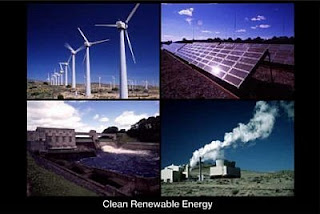
The U.S. is now home to only two of the ten largest solar photo-voltaic producers in the world, two of the top ten wind turbine producers and one of the top ten advanced battery manufacturers. That is, only one-sixth of the world’s top renewable energy manufacturers are based in the United States.

Sustainable technologies in solar, wind, electric vehicles, nuclear and other innovations will drive the future global economy. We can either invest in policies to build U.S. leadership in these new industries and jobs today, or we can continue with business as usual and buy windmills from Europe, batteries from Japan and solar panels from Asia.

Imagine how poor we would be today if U.S. firms did not dominate the top 10 Internet companies. Well, if we don’t dominate the top 10 Energy Technologies rankings now, there is no way we will ever come from behind. No way.

(An article by Thomas Friedman was a source.)

Saturday, May 2, 2009

Antarctica Meets Texas

Texas has a lot of shoreline along the Gulf of Mexico, not much of which is very attractive. For those who have not seen it, imagine a brownish sandpit filled with jellyfish.

As you get a few miles out into the Gulf, and away from the shallow basin of much of our coastline, perhaps it gets a little cleaner and clearer.

But it's that shallow basin and the cities along its shore that has my interest for this post.

The question is what low-lying Texas coastal cities will be affected by the Arctic, Greenland and Antarctic ice sheets melting?

Here are the ones which will be totally submerged: All of the sandbar islands, including Galveston and Padre; Port Aransas; many cities in Matagora Bay; Freeport; much of Galveston Bay, including Texas City; and Port Arthur.

Here are the cities impacted: Orange, Beaumont, Houston, Rockport, and Corpus Christi, Brownsville. On the upside, if you don't already own shoreline properties, you will without having to move. So fellow Texans, enjoy your new view!

For more information, see this link and this one (look for the dropdown, where you can select different cities in many of the coastal states).

Saturday, April 25, 2009

Industry Ignored Its Scientists on Climate

For more than a decade the Global Climate Coalition, a group representing industries with profits tied to fossil fuels, led an aggressive lobbying and public relations campaign against the idea that emissions of heat-trapping gases could lead to global warming.

The coalition was financed by fees from large corporations and trade groups representing the oil, coal and auto industries, among others. Throughout the 1990s, when the coalition conducted a multimillion-dollar advertising campaign challenging the merits of an international agreement, policy makers and pundits were fiercely debating whether humans could dangerously warm the planet.

Environmentalists have long maintained that industry knew early on that the scientific evidence supported a human influence on rising temperatures, but that the evidence was ignored for the sake of companies’ fight against curbs on greenhouse gas emissions. Some environmentalists have compared the tactic to that once used by tobacco companies, which for decades insisted that the science linking cigarette smoking to lung cancer was uncertain. By questioning the science on global warming, these environmentalists say, groups like the Global Climate Coalition were able to sow enough doubt to blunt public concern about a consequential issue and delay government action.

By promoting doubt, industry had taken advantage of news media norms requiring neutral coverage of issues, just as the tobacco industry once had. They didn't have to win the argument to succeed, but only to cause as much confusion as possible.

In other words, the very industry which caused the problem had in its possession the facts of the damage being caused, and they chose to suppress it.

Saturday, January 31, 2009

Who Would You Believe ?

Who would you believe about critical issues?

Let's look at a few of the options: Ned the neighbor, Reg the radio pundit, Paul the politician or Sid the scientist?

From conversations around me, the first three seem to win out over the latter.

What are the qualifications of each? Ned, if he made it through high school at all, perhaps did so with the help of his girl friend -- who has since gone on to become an educator. Reg depends upon inciting ignorance and agitating animus among his listeners. Paul relies on the campaign contributions of the local (and usually polluting) industries in his district.

Sid, however, works in a system set up to reward finding the truth and to punish hiding it. So, as a matter of self-interest, scientists are nudged toward the truth. They suffer a loss of prestige and esteem (and future funding) if someone else fails to replicate an experiment they have used to back up a claim. This is called "peer review."

This past week, Vice President Gore told the Senate that Congress must pass a comprehensive climate bill this year.

Subsequently, Alden Meyer, of the Union of Concerned Scientists said, "Once again, Vice President Gore is speaking the inconvenient truth: It's long past time for the U.S. to join the rest of the world in the fight against global warming, and it's essential for Congress to pass comprehensive climate legislation this year."

Finally, a recent poll among scientists regarding whether there is man made climate change, 92 percent said "Yes".

So who are you going to believe?

Saturday, January 24, 2009

The Rancher and Climate Change

I suspect that our ranchers and farmers will recognize the facts of climate change sooner than some.  That's because it's staring them in the face.

Drought conditions in Texas are so bad cattle are keeling over in parched pastures and dying.

Seventy-one percent of the state is now in some stage of drought. The two worst drought designations - extreme and exceptional - covered 15.1 percent of the state. 

Will that rancher care about the warming in Antarctica?

Maybe not, unless his ranch is along the coast.  But homeowners and businesses along all coastal cities should perhaps be concerned.  

Antarctica warming has major ramifications for sea level rise. Research has found that since 1957, the annual temperature for the entire continent of Antarctica has warmed by about 1 degree Fahrenheit. West Antarctica, which is about 20 degrees warmer than the east, has warmed nearly twice as fast.  

Of course as the sea level rises, our coastal towns and cities sink.  

And who is concerned that trees in old growth forests across the West are dying?  The death rate is doubling every 17 to 29 years, according to a 52-year study published in the Friday edition of the journal Science. The scientists conclude this is probably caused by longer and hotter summers from a changing climate.

These were just three articles that I noticed this past week.  How much longer will ideology continue to ignore facts and subvert science?  How does your congressional representative vote on these issues?  Find out -- it's your planet, too.

Saturday, December 27, 2008

Believe in Clean Coal?

Monday night, 2.6 million cubic yards (the equivalent of 525 million gallons, 48 times more than the Exxon Valdez spill by volume) of coal ash sludge broke through a dike of a holding pond in Tennessee.  

Until I saw this video, I had no idea of the scope.

Apart from the immediate physical damage, the issue is what toxic substances are in that sludge: Mercury, arsenic, lead, beryllium, cadmium. This toxic sludge got into the Emory River, a tributary of the Clinch and Tennessee Rivers: The water supply for Chattanooga, Tennessee as well as millions of people living downstream in Alabama, Tennessee and Kentucky.

Needless to say, the authorities need to get to the bottom of what went wrong and hold the responsible parties accountable.

This sort of thing really makes the proposition of clean coal so absurd. Even if you can scrub all the CO2 out of it, you still have so many other toxic waste products associated with burning coal that have to be stored that carbon emissions are just a part of the problem.

Saturday, December 20, 2008

NASA reports 2008 is ninth warmest year since 1880

The year 2008 was the ninth warmest year since instrumental temperature measurements began in 1880. All of the nine warmest years have occurred in the past 11 years.

The new data is from NASA's Goddard Institute for Space Studies and other government agencies.  It adds to the evidence scientists have been observing about a warming Earth as fossil fuel burning emits heat-trapping gases into the atmosphere.

Britain's Met Office, whose records go back to 1850, has confirmed these facts.

Also, the National Oceanic and Atmospheric Administration on Tuesday summarized these and other trends, including:

The 2008 Atlantic hurricane season was the third costliest, after 2005 and 2004.

The U.S. had nearly 1,700 tornadoes from January through November, which ranks second behind 2004 for the most tornadoes in a year since records began in 1953.

Arctic sea ice in 2008 reached its second lowest level at the end of the melting season in September, following a record low in 2007.  Sea ice loss is important because ice reflects most of the sun's radiation, but open ocean water absorbs most of it, adding to the warming trend both in the ocean and on land.

Many will ignore or deny this evidence and these facts.

My duty is not to convince them against their will.  My duty is to prevent them from achieving public office.  

My duty is to put into place officials who believe in science.  I applaud Barack Obama's choice of John Holdren as his science advisor.

Friday, November 28, 2008

Transition to Green

Cleaner ways to produce and use energy will lead to a stronger economy, leaders of environmental groups said Tuesday.

The recommendations from 29 of the nation's most prominent environmental and conservation groups emphasized a clean-energy approach to economic revitalization.

Leaders of the groups rejected the idea that fighting global warming and protecting the environment would be too expensive in an economic downturn.

Our economy is suffering and so is our environment. The solutions to both go hand in hand.

The report said the stimulus plan was an opportunity to invest in things such as mass transit, renewable energy and weatherization — all of them sources of new jobs.

One of the biggest sources of jobs would be weatherizing homes and buildings to save energy. Studies show that about 40 percent of U.S. greenhouse gas emissions are from wasted energy in buildings.

There also would be jobs in building a new grid to move electricity from solar and wind installations to cities. We have the last century's patchwork of antiquated technology that wastes about a quarter of the energy from coal-fired power plants along the electricity transmission lines.

The full report, "Transition to Green," is available on a joint Web site of the 29 groups.

Sunday, November 23, 2008

Leaving on the Low Road

Throughout the past eight years, the Bush administration has treated our country’s lands as if they belong to industry.

Through a series of short-cut measures and regulations that have cut science and the public out of decision making, the administration has consistently rolled back environmental protections and sharply favored industrial use and exploitation of our wild lands above all other public concerns.

And they’re not done yet.

With just two months left in office, the administration is leaving on the low road. Political appointees are finalizing land management plans, regulations, and policy changes that could severely damage our public lands for decades to come.

There may still be time to hold off irreparable harm to our wild lands if citizens learn about the final outgoing threats and take action now.

Here are some examples of the new last minute rules:
  1. Pushing uranium mining on the edge of Grand Canyon National Park
  2. Legalizing firearms in national parks
  3. Dumping long-standing protections for streams from coal mining waste
  4. Further committing the nation to dirty fuel
  5. Weakening the Endangered Species Act
  6. Opening proposed Wilderness to energy development

Saturday, October 25, 2008

Climate Change Is Faster and More Extreme

Climate change is happening much faster than the world's best scientists predicted and will wreak havoc unless action is taken on a global scale, a new report warns.

The bleak report from WWF also predicts crops failures and the collapse of eco systems on both land and sea.

The agency says that the 2007 report from the Intergovernmental Panel on Climate Change (IPCC) - a study of global warming by 4,000 scientists from more than 150 countries which alerted the world to the possible consequences of global warming - is now out of date.

WWF's report, Climate Change: Faster, stronger, sooner, has updated all the scientific data and concluded that global warming is accelerating far beyond the IPCC's forecasts.

As an example it says the first 'tipping point' may have already been reached in the Arctic, where sea ice is disappearing up to 30 years ahead of IPCC predictions and may be gone completely within five years - something that hasn't occurred for a million years.

It could result in rapid and abrupt climate change rather than the gradual changes forecast by the IPCC.

The report has been endorsed by Professor Jean-Pascal van Ypersele, the newly elected Vice Chair of the IPCC, who said: "It is clear that climate change is already having a greater impact than most scientists had anticipated, so it's vital that international mitigation and adaptation responses become swifter and more ambitious."


Saturday, October 4, 2008

Energy Independence - Electric Vehicles

It is possible to convert our entire ground transportation system to renewable electricity within 10 years. That would require a national mobilization, to be sure, but it can be done.

Such an initiative would prove compelling to the vast majority of Americans. Climate change is abstract, and the strategies to resolve it are remote. Our relationship to our vehicles, on the other hand, is both concrete and visceral. We desperately want to get off oil, especially when gasoline prices rise to $4 per gallon.

But it is more than a pocketbook issue for many of us; it is a moral issue. Americans hate being dependent for our mobility, and therefore for our livelihoods, on countries often hostile to our way of life. Electric cars promise to end that dependency.

We can do this in 10 years because: 1) The average seven-year life expectancy of existing vehicles, and 2) Congress can offer incentives for owners of older gasoline-powered vehicles to trade them in.  (The Republicans have blocked four energy bills this year, all of which included these incentives.)

Let's be clear, the United States is already in competition with the world on manufacturing Electric Vehicles.  We can have a piece of this beginning industry, or we can be left in the electric dust of other nations.  Action or inaction -- our choice.

Here's proof: Norwegian automaker Think Global will be selling its Think electric car in the US. The Think is able to travel up to 110 miles without the need to recharge its batteries, hitting a top speed of 65mph and is 95% recyclable. Two venture capital firms have already been targeted by Think to build the cars in Southern California, hoping to sell around 30,000 to 50,000 of such vehicles annually at $25,000 each.

Saturday, September 6, 2008

Better Aspirations

What have we done lately? Have we had a successful national initiative since 1969 and the moon landing?

If you look back at the recent years, our nation has achieved nothing in which we can take pride in as a nation; some wondrous act that people generations from now will study as examples for an enlightened, productive and just society.

I'm talking about the achievements such as: John Kennedy's challenge to land a man on the moon; Lyndon Johnson's Great Society, and the Civil Rights Act; Dwight Eisenhower's national highway program; Franklin Roosevelt's New Deal, the victory in WWII, the G.I. Bill, and his vision for the United Nations; Theodore Roosevelt's Square Deal, and the regulation of corrupt and monopolistic industries; Abraham Lincoln's ending of slavery, and his superhuman effort to hold our nation together; and finally, the First Transcontinental Railroad, the Monroe Doctrine and the Louisiana Purchase.

Since July 20, 1969, when an American set foot on the moon, what have we done with commitment and pride?

Since that time, a materialistic corruption has ruled American policies. How else can we explain the incompetence, the scandals, the corruption, the waste, the giveaways to those with much, the convicted lobbyists and the no-bid contracts? My explanation is that some in government want government to fail, so that Americans no longer believe that great things are possible. A disengaged citizenry is easier to manipulate.

I have a different view from this. Here are our next great achievements: lift working families out of poverty with supports for transportation, health care, nutrition, child care, education, housing, and other basic needs; resolve conflicts, reduce violence, and defeat terrorism without preemptive war; institute a consistent ethic of life (reduce abortion, end capital punishment, and stop genocide); strengthen human rights and promote human dignity; protect our planet from the interests and activities that damage it (reverse global climate change and develop clean, renewable energy); skillful measures to strengthen families must become a personal and national priority (without scapegoating gays, immigrants, or people diverse race, faiths or ethnicity).

Forty years of nothing is enough. Better aspirations and goals await us. We have been and can be a better nation than this.

So don't believe the lie that government is the problem. We the American people are the government, and it is time that once again we use it for our own greatness and for the benefit of all peoples of our shared planet.

Sunday, August 10, 2008

Energy Fiction vs Reality

America, one of the wealthiest countries on the planet, now pays roughly the same price for oil as the poorest nation, and we respond in immature and irrational ways, stamping our feet and calling for action.

A toxic combination of $4 gasoline, voter anxiety and presidential ambition is making it impossible for this country to have the grown-up conversation it needs about energy. Our presidential candidates are talking about tax gimmicks, tapping into the oil reserve, or drilling everywhere and anywhere now.

Here is the underlying reality: A nation that uses one-quarter of the world’s oil while possessing less than 3 percent of its reserves cannot drill its way to happiness at the pump, much less self-sufficiency. The only plausible strategy is to cut consumption while embarking on a serious program of alternative fuels and energy sources. This is a point the honest candidate should be making at every turn.

Yet four times this summer, Republicans stopped the Senate from taking up legislation that would have provided tax credits to an array of renewable energy entrepreneurs.

Like a nation of small, selfish, petulant children, we cannot rise above politics to establish a policy.

The Union of Concerned Scientists have four things which can start today; it is not dependent on future technologies:

1. Make better cars and SUVs - The technology exists to build cars, minivans, and SUVs that are just as powerful and safe as vehicles on the road today, but get 40 miles per gallon (mpg) or more.

2. Modernize our electricity system - A national standard requiring 10 percent of our electricity to be generated from renewable energy sources by 2020 is an attainable goal. We are already using clean, safe, renewable sources such as solar, wind, geothermal, and biomass (fuel from plant matter) to produce clean energy.

3. Increase energy efficiency in homes and businesses - Like better technology for transportation and power generation, the technology for more efficient motors, appliances, windows, homes, and manufacturing processes is here today.

4. Support American ingenuity - Vigorous support for research and development is critical to achieving practical solutions. Yet, we invest far more in subsidies for the fossil fuel and nuclear industries today than on R&D for renewable energy or advanced vehicle technologies. For instance, Congress appropriated $736 million for fossil fuel research and $667 million for nuclear research in 2001, but only $376 million for all renewable energy technologies combined.

(To this list, I would add building up our railway system, as explained in my post here.)

While the United States has a clear-cut moral responsibility to lead the way internationally, we also have the financial and technical expertise that will help us reap the economic benefits of new markets for clean technology exports. If, however, we choose to sit on the sidelines as the rest of the world moves ahead, we will lose our competitive advantage to Europe and Japan.

Friday, August 1, 2008

Riding the Rails

During the 1850's, the nation was expanding. California had just opened, and there was a need to unite the coasts. The railways were built, largely with federal funding.

Today, for this vast nation with large pockets of clogged highways, AMTRAK has been getting very little federal aid since its creation in 1971 as a public service corporation.

Japan and Western European countries have modern, fast rail services, with modern equipment and solid rail beds coursing throughout their territories with governmental assistance. They are a public service, not meant to make a profit, anymore than public libraries or public schools, although the rail passengers do pay for their tickets.

In our country, AMTRAK has aging equipment, has to use the freight railroad beds and has very little money for rolling stock and track capacity, especially at critical “chokepoints” where delays occur with freight trains.

With soaring gasoline and airfare prices, more Americans need mass transit and AMTRAK to get to their destinations.

The American people have to ask themselves how robust and convenient a modern passenger rail system they want. As good as the one in Canada? As good as the systems in France and Germany?

Given the distances we must travel, the high fuel costs, and the impact of fossil fuels on our environment, America can justify a first-class, high-speed passenger rail system that will save more than it costs.

Saturday, July 19, 2008

Highlights of Al Gore's Challenge

The thing about visionaries is that they don’t imagine what’s easy. They imagine the benefits to be reaped once all the obstacles are overcome. Mr. Gore tells us about the wind blowing through the corridor that stretches from Mexico to Canada, through the Plains states, and the tremendous amounts of electricity that would come from capturing the energy of that wind — enough to light up cities and towns from coast to coast.

“We need to make a big, massive, one-off investment to transform our energy infrastructure from one that relies on a dirty, expensive fuel to fuel that is free,” said Mr. Gore. “The sun and the wind and geothermal are not going to run out, and we don’t have to export them from the Persian Gulf, and they are not increasing in price.

“And since the only factor that controls the price is the efficiency and innovation that goes into the equipment that transforms it into electricity, once you start getting the scales that we’re anticipating, those systems come down in cost.”

The correct response to Mr. Gore’s proposal would be a rush to figure out ways to make it happen. Don’t hold your breath.

When exactly was it that the U.S. became a can’t-do society? It wasn’t at the very beginning when 13 ragamuffin colonies went to war against the world’s mightiest empire. It wasn’t during World War II when Japan and Nazi Germany had to be fought simultaneously. It wasn’t in the postwar period that gave us the Marshall Plan and a robust G.I. Bill and the interstate highway system and the space program and the civil rights movement and the women’s movement and the greatest society the world had ever known.

When was it?

In his speech, delivered in Washington, Mr. Gore said: “We’re borrowing money from China to buy oil from the Persian Gulf to burn it in ways that destroy the planet.”

He describes carbon-based fuel as the thread running through the global climate crisis, America’s economic woes and its most serious national security threats. He then asks: “What if we could use fuels that are not expensive, don’t cause pollution and are abundantly available right here at home?”

Who would you rather listen to: The nay-sayers or the visionaries? Visit this link to learn more.

Saturday, June 28, 2008

20 Percent Wind

Wind power can play a major role in meeting America's increasing demand for electricity, according to a groundbreaking technical report (click here).

The report recommends that the nation sets a goal to implement a 20% Wind Scenario by the year 2030.

New wind power installations would increase to more than 16,000 MW per year by 2018, and continue at that rate through 2030. No technological breakthroughs are needed. In the 20% Wind Scenario, 46 states would experience significant wind power development.

The report finds that by 2030, the U.S. wind industry could:

  • support roughly 500,000 jobs in the U.S., with an annual average of more than 150,000 workers directly employed by the wind industry;
  • support more than 100,000 jobs in associated industries (e.g., accountants, lawyers, steel workers, and electrical manufacturing);
  • support more than 200,000 jobs through economic expansion based on local spending;
  • increase annual property tax revenues to more than $1.5 billion by 2030; and
  • increase annual payments to rural landowners to more than $600 million in 2030.
Using more domestic wind power will diversify the nation's energy portfolio — adding wind-generated electricity at stable prices — and strengthen national energy security.

Sunday, June 22, 2008

Because the world needs to know : 350

The science is clear, and politicians argue over policy. Carbon dioxide is causing global warming and human activity is the cause of the rapid release of CO2.

Watch this 90 second animation to learn a little more. It's goal is to build an echo chamber so that the number 350 is heard everywhere, with increasing volume.

Saturday, June 7, 2008

Problems aren't solved by delaying action

If you were mortally ill and the doctors had diagnosed the illness and prescribed a treatment, would you ignore them?

It’s very clear that our planet is warming -- warming is unequivocal. The odds are nine out of ten, that most of the warming is from increasing greenhouse gases. Greenhouse gases are coming mainly from burning fossil fuel.

All life on earth is carbon based. You, me, the trees, the fishes and the birds -- everything. When oil or coal is burned and combined with oxygen, carbon dioxide is released. This is science, not politics.

Climate change and global warming isn't only about a few polar bears. It is about rainfall and snowfall and water supplies and irrigation and agriculture and food. A 10 or 20 percent change in rainfall is life or death for agriculture. So particularly in very dry areas, places like Africa where there isn’t much in the way of irrigation, it’s basically rain-fed or it doesn’t happen. Changes in rainfall will have potentially a very, very large impact. Last year, the Australian droughts have had a significant impact on their wheat production. American farmers, particularly in the West, are seeing similar trends.

Recently, more than 1,700 of the nation's most prominent scientists and economists released a joint statement calling on policy makers to require immediate, deep reductions in heat-trapping emissions that cause global warming. You can read their statement here.

The statement notes that acting quickly to cut global warming pollution would be the most cost-effective way to limit climate change. If the U.S. delays taking action, future cuts would have to be more drastic and would be more expensive. Smart reduction strategies now would allow the economy to grow, generate new domestic jobs, protect public health, and strengthen energy security.

As clear as the science is, our representatives in the Senate turn it into politics, and have delayed for another year any action.

Monday, April 21, 2008

April 22 - Happy Earth Day !

Visit the Dhammakaya Foundation Site

Each year, the April 22 Earth Day marks the anniversary of the birth of the modern environmental movement in 1970. Among other things, 1970 in the United States brought with it the Kent State shootings, the advent of fiber optics, "Bridge over Troubled Water," Apollo 13, the Beatles' last album, the death of Jimi Hendrix, and the meltdown of fuel rods in the Savannah River nuclear plant near Aiken, South Carolina -- an incident not acknowledged for 18 years. At the time, Americans were slurping leaded gas through massive V8 sedans. Industry belched out smoke and sludge with little fear of legal consequences or bad press. Air pollution was commonly accepted as the smell of prosperity. Environment was a word that appeared more often in spelling bees than on the evening news. But Earth Day 1970 turned that all around. On April 22, 20 million Americans took to the streets, parks, and auditoriums to demonstrate for a healthy, sustainable environment.